
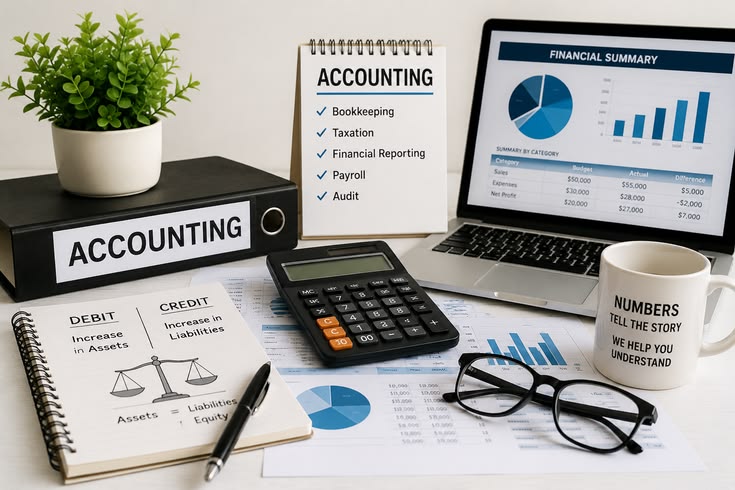
Accurate financial records are essential for running a successful business. From tracking daily transactions to preparing financial statements, accounting helps business owners understand their financial position, monitor expenses, manage cash flow, and make informed decisions. Without an organised accounting system, businesses may struggle to identify financial discrepancies, prepare reliable reports, and meet their reporting obligations.
Accounting services help businesses maintain accurate books, organise financial information, and establish a clear picture of their financial performance. Whether you operate a startup, small business, partnership firm, LLP, or established company, professional accounting support can help streamline financial processes and improve operational efficiency.
By maintaining reliable records and following consistent accounting practices, businesses can focus on growth while keeping their financial information organised and accessible.
What Are Accounting Services?
Accounting services involve recording, classifying, reviewing, reconciling, and reporting a business’s financial transactions. These activities help convert day-to-day financial data into meaningful information that supports planning, compliance, and business decisions.
Depending on the organisation’s needs, accounting services may include bookkeeping, accounts payable and receivable management, bank reconciliation, financial statement preparation, expense tracking, general ledger maintenance, and management reporting.
Professional accounting support can be provided on a recurring basis or for specific requirements, such as preparing financial records for year-end reporting.
Importance of Accounting Services for Businesses
A well-maintained accounting system helps businesses understand where money comes from, where it is spent, and how financial resources are being used.
1. Accurate Financial Records
Organised books provide a reliable record of income, expenses, assets, liabilities, and other financial transactions. This information supports financial reporting and helps identify discrepancies.
2. Better Cash Flow Management
Regular monitoring of receivables, payables, and bank balances helps management understand upcoming financial commitments and plan payments more effectively.
3. Informed Business Decisions
Accurate financial reports help business owners evaluate profitability, monitor operating costs, and assess the financial implications of business decisions.
4. Support for Tax and Regulatory Compliance
Proper accounting records help businesses prepare information required for applicable tax returns, audits, statutory reporting, and other compliance activities.
5. Improved Operational Efficiency
A structured accounting process reduces manual recordkeeping, helps organise supporting documents, and creates consistency across financial activities.
6. Greater Financial Transparency
Reliable reports give owners and management better visibility into financial performance and help them review business results with greater confidence.
Our Key Accounting Services
1. Bookkeeping Services
Bookkeeping is the foundation of the accounting process. It involves recording financial transactions systematically and maintaining supporting documentation.
Bookkeeping services may include:
- Recording sales and purchase transactions.
- Maintaining income and expense records.
- Recording receipts and payments.
- Classifying transactions under appropriate ledger accounts.
- Maintaining general ledger entries.
- Organising invoices, bills, and supporting documents.
- Reviewing records for missing or inconsistent information.
Consistent bookkeeping helps businesses maintain up-to-date financial records and simplifies the preparation of financial statements.
2. Accounts Payable Management
Accounts payable refers to amounts a business owes to suppliers, vendors, and other parties. Managing these obligations properly helps maintain reliable records and supports timely payment planning.
Accounts payable services may include:
- Recording supplier invoices and bills.
- Reviewing invoices against available supporting documents.
- Maintaining vendor account records.
- Tracking outstanding balances and due dates.
- Reconciling supplier statements.
- Preparing payment schedules for review.
- Identifying duplicate entries or discrepancies.
A structured accounts payable process helps businesses improve visibility over outstanding obligations and maintain better supplier relationships.
3. Accounts Receivable Management
Accounts receivable represents amounts customers owe for goods or services supplied by a business. Effective management helps organisations monitor collections and understand their outstanding revenue.
Accounts receivable services may include:
- Recording customer invoices.
- Maintaining customer account ledgers.
- Tracking outstanding payments.
- Reconciling customer accounts.
- Preparing receivables ageing reports.
- Identifying overdue balances.
- Providing periodic collection-related reports.
Regular receivables monitoring helps management identify delayed payments and make more informed cash flow decisions.
4. Bank Reconciliation
Bank reconciliation involves comparing accounting records with bank statements to identify differences and confirm that transactions have been recorded accurately.
This process may include reviewing deposits, withdrawals, bank charges, interest entries, transfers, and outstanding transactions.
Bank reconciliation services help businesses:
- Identify missing or duplicate entries.
- Investigate differences between bank and book balances.
- Verify recorded receipts and payments.
- Maintain accurate cash and bank records.
- Detect unusual transactions for further review.
- Improve the reliability of financial reporting.
Regular reconciliation is an important internal control for businesses of all sizes.
5. General Ledger Maintenance
The general ledger contains the main accounts used to record and classify financial transactions. It forms the basis for preparing trial balances and financial statements.
General ledger services may include recording journal entries, reviewing account classifications, reconciling ledger balances, maintaining account schedules, and investigating unusual balances.
A properly maintained general ledger supports consistent reporting and makes it easier to review financial information at the end of an accounting period.
6. Financial Statement Preparation
Financial statements provide an overview of a business’s financial position and performance over a specified period.
Depending on the entity and reporting requirements, accounting support may include preparing or assisting with:
- Balance sheets.
- Profit and loss statements.
- Cash flow statements.
- Trial balances.
- Supporting schedules and account reconciliations.
- Management reports.
The preparation and presentation of financial statements should follow the accounting framework and reporting requirements applicable to the business. Where an independent audit or professional certification is required, it must be undertaken by an appropriately qualified and authorised professional.
7. Expense Tracking and Cost Management
Monitoring expenses helps businesses understand operating costs and identify areas where spending requires further review.
Expense-related accounting services may include classifying expenses, recording reimbursements, reviewing supporting documents, monitoring recurring costs, and preparing expense summaries.
These records can help management compare actual spending against budgets and evaluate the financial impact of operational decisions.
8. Payroll Accounting Support
Payroll accounting involves recording salary expenses, employee-related liabilities, deductions, and payroll payments within the accounting system.
Services may include:
- Recording salary and wage expenses.
- Reconciling payroll reports with accounting records.
- Recording applicable employee deductions and liabilities.
- Maintaining payroll-related journal entries.
- Reviewing salary payment records.
- Supporting applicable payroll tax and statutory reporting processes.
Payroll calculations and employment-related compliance should be coordinated with the relevant payroll and compliance processes to ensure consistency across records.
9. Year-End Accounting and Closing
Year-end accounting involves reviewing financial records and preparing accounts for the end of a financial year or reporting period.
This process may include reconciling ledger balances, reviewing outstanding receivables and payables, recording applicable adjustments, checking fixed asset records, and preparing supporting schedules.
A structured closing process helps businesses prepare reliable financial information for tax reporting, statutory requirements, management review, and applicable audit procedures.
10. Management Reporting
Management reports help business owners and decision-makers understand financial performance beyond basic transaction records.
Depending on the business’s requirements, reports may cover revenue, expenses, profitability, receivables, payables, cash flow, and budget comparisons.
Regular reporting can help management identify trends, investigate unusual changes, and plan financial resources more effectively.
Our Accounting Services Process
A consistent accounting workflow helps maintain accuracy and transparency throughout the reporting period.
Step 1: Understand Your Requirements
Review the business structure, transaction volume, existing accounting system, reporting needs, and current recordkeeping practices.
Step 2: Collect Financial Documents
Organise bank statements, sales invoices, purchase bills, expense records, payroll reports, and other relevant supporting documents.
Step 3: Record Transactions
Enter and classify financial transactions in the accounting system using the information and documentation provided.
Step 4: Reconcile Accounts
Compare ledger balances with bank statements, supplier records, customer accounts, and other relevant supporting information.
Step 5: Review Financial Records
Identify missing documents, unusual balances, duplicate entries, and inconsistencies requiring clarification.
Step 6: Prepare Reports
Generate relevant financial statements, reconciliations, and management reports according to the agreed reporting schedule.
Step 7: Maintain Ongoing Records
Follow a consistent process for updating books, organising documents, and preparing information for applicable reporting and compliance requirements.
In-House Accounting vs. Outsourced Accounting Services
Businesses can maintain accounting internally or engage an external provider, depending on their needs and available resources.
An in-house accounting team offers direct internal coordination and may be suitable for businesses with substantial or complex daily accounting requirements. Outsourced accounting services can provide access to accounting support without requiring the business to manage every accounting function internally.
Outsourcing may be worth considering when a business needs flexible support, help with transaction backlogs, regular bookkeeping, or financial reporting assistance. The right arrangement depends on transaction volume, confidentiality requirements, internal controls, budget, and reporting complexity.
Regardless of the model selected, businesses should maintain appropriate access controls, document retention procedures, approval workflows, and review mechanisms.
Common Accounting Challenges Faced by Businesses
Businesses may encounter accounting difficulties when financial records are updated inconsistently or supporting documents are not maintained properly.
Common challenges include:
- Delayed transaction recording.
- Missing invoices and expense receipts.
- Differences between bank statements and accounting records.
- Unreconciled supplier and customer balances.
- Incorrect account classifications.
- Limited visibility into outstanding payments.
- Incomplete financial reports.
- Backlogs in year-end accounting.
- Inconsistent communication between finance and operations teams.
Regular bookkeeping, timely document submission, defined responsibilities, and periodic reconciliations can help address these challenges.
Who Can Benefit from Accounting Services?
Professional accounting support can benefit:
- Startups and newly established businesses.
- Small and medium-sized enterprises.
- Private limited companies and public companies.
- Partnership firms and LLPs.
- Consultants and professional service providers.
- Retailers, traders, and service businesses.
- Businesses managing multiple vendors or customer accounts.
- Growing organisations that need regular financial reporting.
Accounting requirements differ across industries and business structures. Services should therefore be tailored to the organisation’s transactions, reporting needs, and applicable accounting requirements.
Frequently Asked Questions (FAQs)
What do Accounting Services include?
Accounting services may include bookkeeping, accounts payable and receivable management, bank reconciliation, general ledger maintenance, financial statement preparation, expense tracking, payroll accounting support, and management reporting.
Why are accounting services important for small businesses?
They help small businesses maintain reliable financial records, monitor cash flow, track expenses, understand profitability, and prepare information needed for applicable tax and compliance requirements.
How often should accounting records be updated?
The appropriate frequency depends on transaction volume and business requirements. Many businesses benefit from recording transactions regularly and reconciling important accounts at consistent intervals.
What documents are required for accounting services?
Common documents include bank statements, sales invoices, purchase bills, expense receipts, payment records, payroll information, loan statements, and details of assets and liabilities. Additional documents may be required depending on the nature of the business.
Can accounting services be outsourced?
Yes. Businesses can outsource selected accounting functions or engage an external provider for ongoing bookkeeping and reporting support. The arrangement should define responsibilities, document access, review procedures, confidentiality, and deliverables.
Are accounting services the same as auditing?
No. Accounting focuses on recording, organising, reconciling, and reporting financial information. An audit is a separate examination performed under applicable professional and legal requirements by an appropriately qualified and authorised auditor.
Do accounting services include tax filing?
Some accounting service providers also offer tax and compliance support, while others focus only on bookkeeping and financial reporting. The scope should be confirmed before engagement.
Strengthen Your Financial Management with Professional Accounting Services
Reliable accounting is more than recording transactions. It helps businesses maintain financial clarity, understand operating performance, manage outstanding balances, and prepare for important business decisions.
With organised records, consistent reconciliations, and meaningful financial reporting, businesses can build stronger accounting processes and improve visibility over their financial position.
Whether you need ongoing bookkeeping, accounts payable and receivable management, bank reconciliation, year-end accounting, or regular financial reports, the right accounting support can help you establish a process suited to your business.
Looking for dependable Accounting Services for your business? Connect with a professional accounting team to discuss your recordkeeping needs, reporting requirements, and the level of support that best fits your operations.